

Change Management
Leveraging Change Management for Success
Change management is the discipline of helping organizations — and the people in them — successfully navigate transitions. It's about making sure that when something changes, people understand why it's happening, know what's expected of them, and feel supported enough to actually change how they work. Done well, it's the difference between a new system that gets embraced and one that gets used exactly once before everyone quietly goes back to the spreadsheet. Or between a reorganization that energizes your team and one that triggers a quiet exodus of your best people.
Change Management
Change is hard. Anyone who tells you otherwise is either selling something or hasn't been through very much of it.
Whether you're rolling out new technology, restructuring your organization, or shifting the way your people work, the technical side of change is rarely what trips you up. It's the human side. People are complicated. They have opinions, habits, histories, and an impressive ability to keep doing things the way they've always done them — even when everyone agrees the old way wasn't great. At Colleague Consulting, we work with organizations going through two of the most common — and most humbling — types of change.
Organizational Change
Organizational change might mean restructuring teams, shifting leadership, redefining roles, merging departments, or fundamentally changing how work gets done. These changes touch people's identities and routines in ways that go deeper than most leaders anticipate — usually right around the moment they're standing in front of a town hall wondering why no one looks excited.
Even when the strategic rationale is airtight, organizational change fails when communication is inconsistent, when leaders aren't aligned with each other, or when employees feel like things are happening to them rather than with them. Resistance isn't a sign that people are difficult. It's usually a sign that something about the change hasn't been made clear, credible, or fair. (Sometimes people are also just difficult. We can help with that too.)
We help senior leaders work through this deliberately. That starts with an honest assessment of your organization's readiness for change and a clear picture of who is most affected and how. From there, we develop structured communication plans that give people the right information at the right time, engagement strategies that bring key stakeholders along early, and coaching for leaders so they can show up consistently and credibly — not just at the announcement, but through all the messy middle parts.
For a company going through a leadership restructure, for example, the biggest risk often isn't the org chart itself. It's the six months of hallway speculation while people wonder what it means for them. We help compress that uncertainty window and give people a reason to stay focused and committed — rather than refreshing LinkedIn.
Technology Change
Technology implementations are where change management has some of its most measurable impact — and where it is most enthusiastically skipped.
A new ERP system, CRM platform, cloud migration, or digital workflow tool represents a significant investment. The technical build might go flawlessly. But if the people using it don't understand it, don't trust it, or quietly revert to their old habits the moment you stop watching, that investment doesn't deliver its promised return. Studies consistently show that the majority of large IT projects underperform not because of technical failure, but because of adoption failure. The software worked. The humans did not cooperate.
We work alongside IT leaders and project teams to make sure the human side of a technology rollout gets as much planning and attention as the technical side — which means getting involved early, not at go-live when everyone is already exhausted and slightly resentful.
In practice, that looks like stakeholder analysis to identify which teams are most affected and what their specific concerns are likely to be, communications planning that demystifies the technology and sets realistic expectations, training strategies that go beyond a single two-hour session that everyone forgets by Thursday, and feedback loops that surface resistance or confusion quickly before it hardens into folklore.
Consider a company rolling out a new enterprise platform across multiple departments. The project team has a detailed technical plan and a go-live date. What's often missing is a parallel plan for the people: Who needs to fundamentally change how they do their job? What do they stand to gain — or fear losing? Who are the informal influencers whose buy-in will make or break adoption on the floor? These are the questions we help you answer — preferably before go-live, not after.
Our Approach
We don't believe in change management frameworks for their own sake. Heavyweight methodologies that generate impressive documentation and then sit on a shelf help no one except the people who billed for them. Our approach is practical, proportionate, and built around your specific situation.
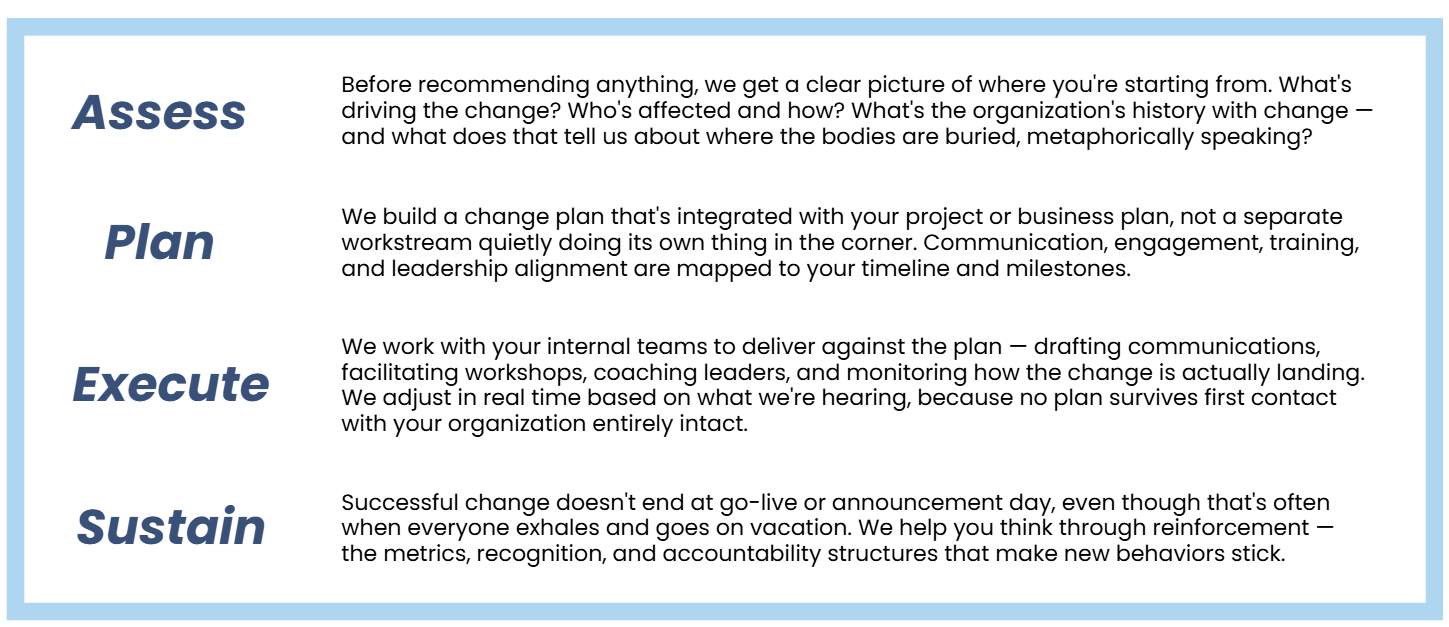
We typically work through four phases:
Why It Matters at the Leadership Level
For C-suite leaders, the case for investing in change management is straightforward: it protects the return on your strategic investments. A major organizational redesign or technology transformation is expensive. The cost of doing it poorly — lost productivity, disengaged employees, failed adoption, having to redo the whole thing eighteen months later — is almost always higher than the cost of doing it right the first time.
For IT leaders, it means your project doesn't become the one everyone references at the next all-hands as an example of what not to do. It means go-live isn't the end of a grueling road but the beginning of an organization actually working differently and better.
Change management done well is largely invisible. People just experience the change as well-run, well-communicated, and well-supported. There's no parade. But things work. That's what we're going for.
Working With Colleague Consulting
We bring deep experience in both organizational and technology-driven change, and we know how to operate effectively alongside executive teams, HR functions, and IT project offices. We're pragmatic partners, not process enforcers. We focus on outcomes, not outputs — and we've yet to meet a change challenge that was improved by more jargon.
If you're facing a major transition and want it to actually stick, we'd love to talk.